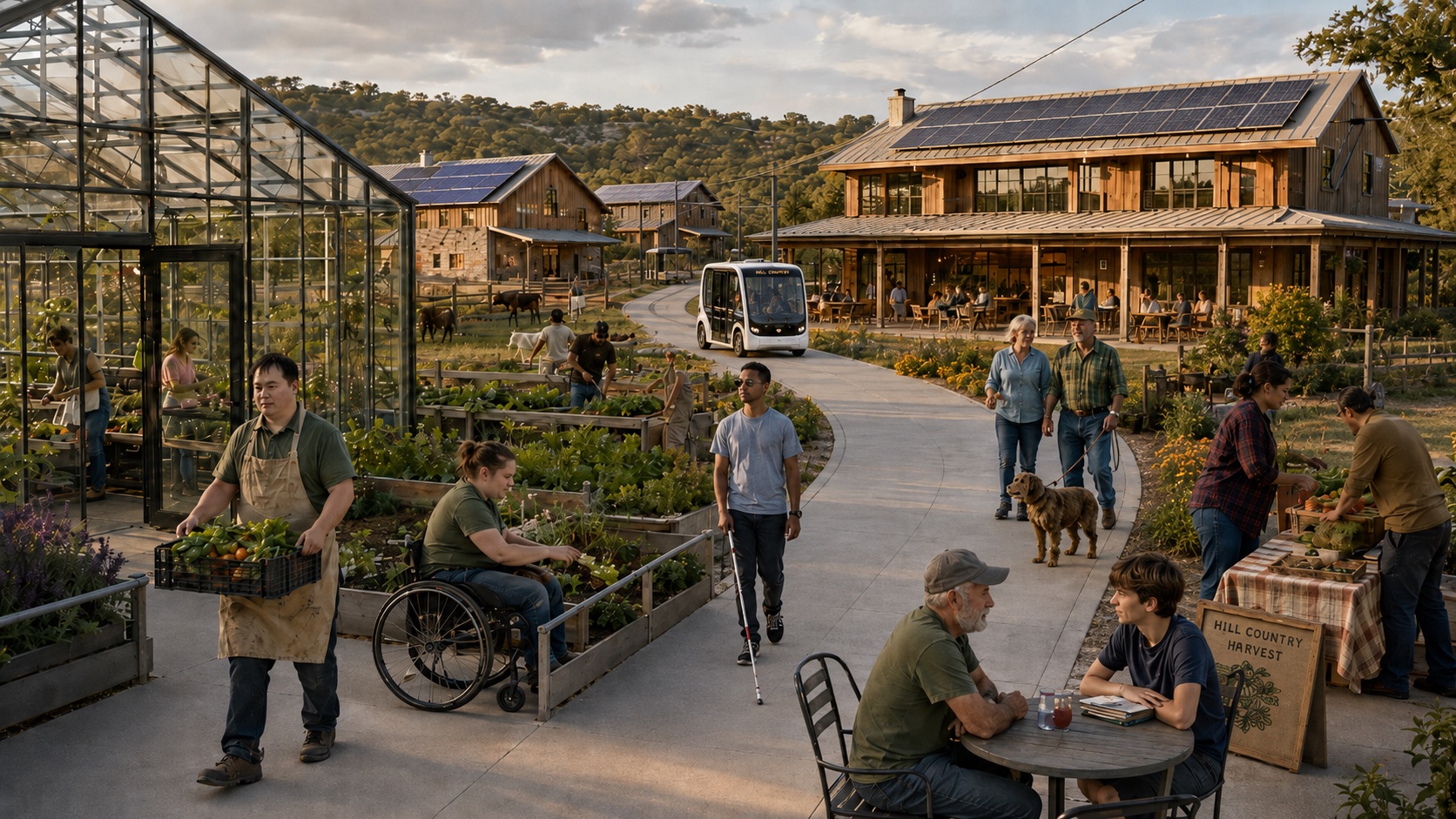
Not a facility. Not a group home. A real town, powered by the sun, with gardens and workshops and restaurants and jobs — cooperatively owned by the people who live in it.
That should be an ordinary hope. For me it comes attached to a question I have never been able to answer: who helps him then, and what kind of life will he have?
Eduardo is twenty-one. He knows a storm is coming before the rest of us do — he has been telling us about the weather since he was six, and he is almost always right. He unloads the dishwasher. He shreds the mail. He gives himself his own insulin. He beats me at basketball every single time we play.
He does not speak in full sentences. He needs help with money, and with stairs.
He loves doing stuff that he can actually do.
There is nowhere in this country built on that sentence. So I am going to build one.
Texans waiting for a Medicaid HCS residential services slot,
as of March 2026. More than 198,000 across all six state lists.
Sign up when your child is three, and you get the call when they are twenty-one.
Sign up at eighteen, and you get the call at thirty-six — if you are still alive to answer it.
A self-sustaining town of roughly 300 to 500 people in the ring around Austin. About half the residents have disabilities. The rest are families, neighbors, retirees, and people who simply want to live there.
Every piece of this is already proven somewhere. Geel, Belgium has welcomed people with disabilities into family homes for seven hundred years. De Hogeweyk in the Netherlands built a real village for people with dementia. Brookwood in Texas employs more than 250 adults with disabilities in its own businesses. Feldheim, Germany generates one hundred percent of its own power.
Nobody has put them together. That is the whole opportunity.
Not money. Not land. Not a developer.
Parents who want this for their own son or daughter, and who are willing to help figure it out. Every community I have studied started exactly this way. Marbridge began in 1953 with six young men in a farmhouse and now serves 275 adults on 200 acres. Down Home Ranch started as a summer camp.
If you lie awake with the same question I do — not will my child be safe when I am gone, but will my child have a life when I am gone — I would like to talk to you.
I read every one of these myself, and I will get back to you personally. It may take a few days.